
Swarming/Polyrhythmic Swarming
Let our Music be Jazz. / Netwar First Raw Efforts

Polyrhythmic swarmingIf you're going to use swarm tactics, then learn from nature. The hum of swarms is music, your music should be Jazz.
(Allow author some musical metaphor please.)
Follow statelier, ordered music and you'll be neatly penned and slaughtered. Follow rap you can forget coordination, or any logic. Hence, you'll be piecemeal slaughtered.
Jazz: The groups cross and coordinate on strike notes ... but are not the same operationally. This confuses competitors thinking and counter-swarm response. It also allows temp flash mobs of mass. Which then diffuse after striking. An intelligent enemy answers swarms with first counter-swarms to hold them then masses forces to crush the swarms one by one. They would naturally look to a point of massing by their enemy as the decisive point they've been waiting for then strike with reserves. If there is a sudden massing and striking followed by diffusion again this will confuse, especially if then suddenly a massing occurs again somewhere else.
They are constantly to be nailing at a swarm of stinging bees who strike then move on. The object of the flash swarms is not the holding of territory or even the destruction of enemy forces - although they should be hurt in every engagement. It's to mount constantly shifting attacks with sudden concentrations in place and time that diffuse and strike pain, then diffuse and move rapidly elsewhere for the next strike to overwhelm the senses of enemy Command and Staffs and denying them any insight into our decision loop and providing no place or time to mass their forces.
The best defense of the foe against swarms is to have local security forces of militia, police, even deputized armed citizens hold the local areas until heavy reaction forces arrive. So, it's critical that these forces be identified, suborned, intimidated or some way undermined and neutralized before, during and after engagements. This is the paramount object of the local Intelligence battle.
Cluster leadership, swarming, and network meshes.
Cluster approach to leadership: if one fails all do not fail.
Cluster leaders may be defined by sectors of either geography or function. Functions such as bulk logistics and transportation, the overall intelligence effort, medical and so on. The Cluster Lead in a sector may be elected, directed, or simply defaulted to by expertise in that area [such as medical]. The lead cell or cluster of cells accept responsibility for coordination, direction of the overall effort, facilitation between disparate groups.
This is particularly useful three times:
*Disparate groups
• Swarming tactical leadership
• Meshing of nodes in the network. Remember your goal should be to build a network mesh, and to adapt it around tactical circumstances either offensively or defensively. A mesh for instance is ideal for controlling swarming cells, it can adapt around the enemy faster than traditional formations using the obsolete Command and Control TOC model. The entire idea of a mesh is if a cell/node is destroyed or the links to it cut the network regenerates or adapts around the damage. Similarly if an enemy is being beaten or is in disorder the mesh exploits his disorder by better organizing and massing swarming elements into his formations.
• The minutemen at Concord did fine, but it was a bunch of armed gangs with rifles running towards the British formations. As the Redcoats took fire from all sides - but not organized swarming attacks - they suffered 50% casualties but withdrew to Boston intact and in good order. The Mongols or Parthians would have annihilated them.
• The Rifle behind every blade of grass is all very well but let us optimize it for efficiency. That is the swarm, the gang, the natural human way of battle and the hunt, and the great organizer of swarm attacks is the network. This is how the RAF won the Battle of Britain, and how the U-Boats nearly won - swarming attacks organized as a network.
A mesh exists when each cell has at least two links to the rest of the network.
This is a meshed network, every cell has at least two links to other cells/nodes.
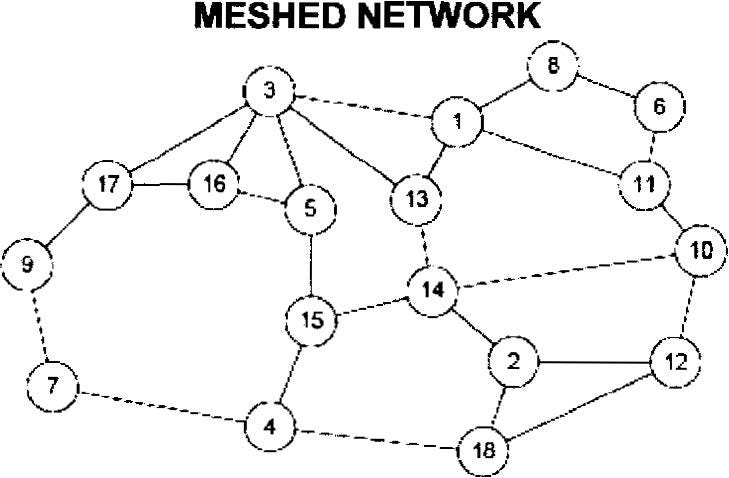
Meshed connections allow restoration and to move around disruption, or to shape the mesh around opportunity.
Now you may also imagine this mesh as a web. If a column advances into mesh, a meshed network can break individual links and connections. However, the web will then close around it, or certainly should, enmeshing the intruder. Similarly, a static position or disrupted, fleeing enemy could have a mesh connected around it, enmeshing, immobilizing and then destroying said enemy.
The point of the network mesh again isn't just rapid regeneration after disruption or defeat. It's the natural organization of swarms around an attacking or retreating enemy.
When you combine networking with swarming this is more than a mesh.
It's a spider’s web.
You have just described the Israeli failure on Oct. 7. The failure to have organized armed citizens/militia next door to 2M murderous lunatics pretty much doomed their response.